
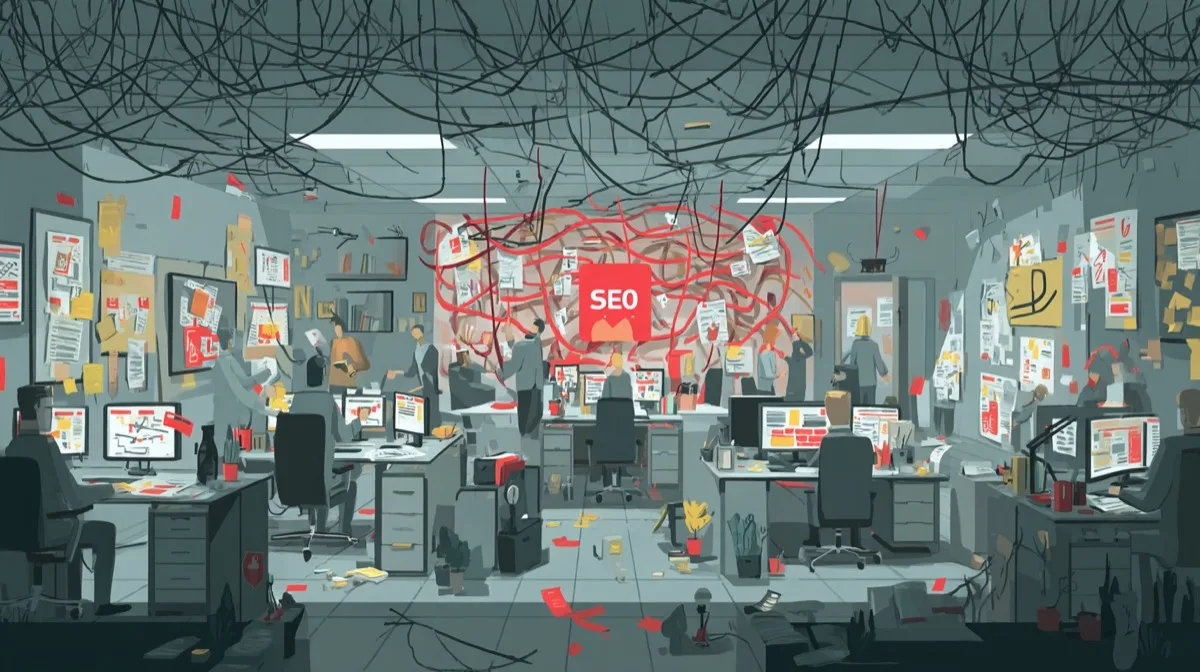
SEO sits in a strange spot on most org charts - somewhere between marketing, product, and engineering. It's not quite feature work, not quite growth, and it usually moves too slowly to compete with roadmap priorities. That's why SEO projects, even the well-scoped ones, routinely fail to ship.
Here's where we've seen it break down, and what tends to fix it.
1. No single owner
SEO work usually has no clear owner. Marketing wants the traffic, engineers control the implementation, and product isn't sure where it fits. That gap in ownership leads to broken accountability and half-finished execution.
The fix: assign one directly responsible person. Ideally a product manager or tech lead with enough context to weigh SEO requirements against roadmap priorities.
2. No business case tied to product goals
"More traffic" doesn't get prioritised in sprint planning. Product teams need metrics that tie directly to their own goals - signups, engagement, activation, retention. Most SEO tickets fail here. They read like generic to-dos, not outcomes.
The fix: reframe SEO in terms of business impact. For example: "Fix crawl budget inefficiency to improve indexation of converting pages," or "Resolve JavaScript rendering issues to increase indexed product pages and lift organic add-to-cart." If it doesn't map to the funnel, it won't get resourced.
3. Requirements too vague for engineers
SEO requests often arrive as one-liners: "make this crawlable" or "add canonical tags." That's not a spec, that's a Slack message. Engineers don't build from ambiguity, and product won't prioritise it either.
The fix: turn SEO into a structured, actionable ticket - context (why it matters), scope (which pages or sections), dependencies, acceptance criteria, and a metric for success. Treat it like technical debt: specific, measurable, and clearly defined.
4. Engineering doesn't see it as a priority
If your dev team thinks SEO means meta tags, it won't make the sprint, especially when they're already juggling bugs, feature launches, and infrastructure work. And to be fair, product teams don't always push for it either, because it gets filed under "nice to have" instead of "must ship."
The fix: position SEO as product infrastructure - no different to page speed, uptime, or accessibility. It affects discoverability and conversion, and it compounds over time. Bring the numbers to the table: lost revenue from poor indexation or visibility gaps.
5. SEO moves in months, product moves in sprints
Product ships in six-week cycles. SEO typically needs three to six months to show real traction. That mismatch makes it a hard sell - leadership wants a short feedback loop, and SEO usually can't deliver inside that window.
The fix: break SEO into shippable units. Don't pitch a six-month roadmap, pitch a two-sprint pilot. For example: "Clean up internal linking for our top 100 converting pages, then measure crawl path improvements and indexed page count after 30 days." Smaller bets validate faster and are an easier sell to stakeholders.
6. SEO isn't part of product decisions
Most visibility problems start with product decisions - URL migrations, infinite scroll, JavaScript frameworks, localisation logic. But SEO isn't looped in until after something breaks, at which point it's purely reactive.
The fix: build SEO into the design and development checklist - URL structure, content rendering paths, canonical strategy, pagination and infinite scroll behaviour. If it touches crawlability, indexability, or content visibility, SEO should have a seat at the table before the decision is made, not after.
The bottom line
SEO isn't just a marketing channel. It's a constraint to manage and a source of growth that compounds over time. When it fails, it's rarely down to a skills gap. It's because nobody treated it like product work in the first place.
This is the same thinking behind how we scope SEO work for clients - a clear owner, a business case tied to real numbers, and honesty about what won't move in the first month. If a piece of work won't clear that bar, we'll tell you before we bill for it.

Rifat Hasnat
Product Manager, Whizz People